
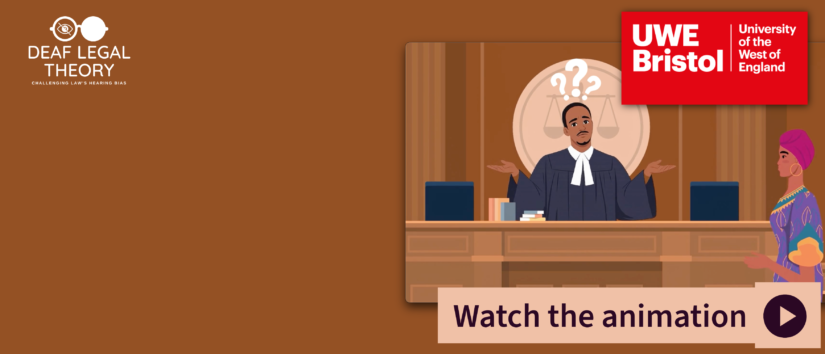
The Deaf Legal Theory Model Animation
The Deaf Legal Theory (DLT) Model is a practical framework for examining law, policy and practice from deaf perspectives.
This animation provides an accessible introduction to the DLT Model, taking viewers through the Model and the questions it encourages us to consider when examining how law affects deaf people.
About the DLT Model
The DLT Model was developed through the Co-Producing the Deaf Legal Theory Model project.
The co-production process began with the BIG Survey, which received 243 responses from deaf people, professionals and academics around the world. The responses were initially analysed into 21 themes, which were then explored and refined through a Working Group into nine core themes.
These themes informed three possible versions of the DLT Model. A Development Workshop brought together members of the Working Group and participants recruited through the BIG Survey to consider the different approaches and help shape the final Model.
The result was the co-produced DLT Model (see Figure 1), bringing together elements of the different proposals into a practical framework that can be applied to law, policy and practice.

What is the animation for?
The animation has been developed to make the DLT Model easier to understand, teach, discuss and use.
It can be used by deaf communities, researchers, students, legal and non-legal professionals, policymakers, advocates and anyone interested in examining how law and policy affect deaf people.
The animation can be used alongside the DLT Model and the project’s Final Report, which provides more detail about the co-production process and development of the Model.
What happens next?
The DLT Model continues to develop and be tested in different contexts.
It is now being tested internationally, beginning with a pilot project in Ghana, working with deaf people to explore how well the Model reflects deaf experiences within a different legal, linguistic and cultural context.
This work will help us understand how the Model operates beyond the context in which it was originally developed and identify how it might need to evolve as Deaf Legal Theory develops internationally.